On Father’s Day morning, I woke to the glorious sight of a sea turtle nest built directly in front of our condominium in Satellite Beach, FL. I saw the intricate and unmistakable pattern of sea turtle flippers as they traversed the beach to the dune where a wildly dug pit with sand piled high around it was created. I was overjoyed.
Many of you know that last summer I wrote Sea Turtles Teach Enduring Lessons for Well-Schooled, the site for educator storytelling. I have a passion for these savvy creatures from whom we can all learn life lessons.
I watch with great interest each morning as members of the Marine Turtle Research Group of the University of Central Florida drive up the beach in their Gator to check on nests, and seek new ones. They also found the nest on Father’s Day and posted a sign for it as they searched the area with clipboards noting tides, currents, and locating tracks in the largest loggerhead sea turtle nesting area in the Western Hemisphere. Volunteer opportunities exist for oversight and overnight monitoring. This is my retirement plan.
Sea turtles have survived in the Earth’s oceans for the last 110 million years. Recent research has found that turtles have remarkably slow rates of aging. Thus, they can live a very long time – 50 to 100 years. They migrate thousands of miles in their lifetime through ocean basins and high seas.
Once they are fully grown, turtles head back to where they were born to mate, even if they have not been there for 30 years. Males never leave the ocean, enjoying a Father’s Day swim, while females come ashore to lay their eggs on sandy beaches. In a single nesting season, females lay between two and six clutches of eggs, each containing 65 to 180 eggs. That means in their lifetime they could produce 4,200 eggs!
The sea turtle’s perseverance is extraordinary. Here are my top three life lessons we can learn from sea turtles.
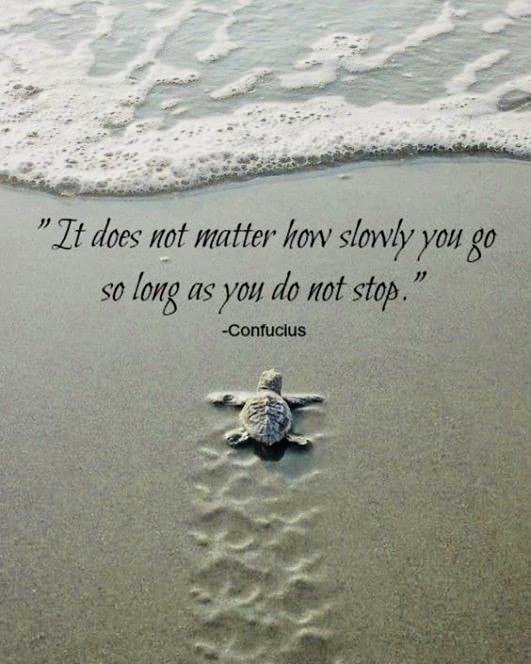
Lesson #1 It does not matter how slowly you go, so long as you do not stop. (Confucius)
From the moment a baby sea turtle leaves the confines of its nest danger is ever present. While it may leave the nest with its siblings, much of its singular journey will be spent alone. Turtles understand it is a marathon, not a sprint. Their undertaking takes place over a long distance and over a long period of time which demands great physical and mental stamina. Turtles, known for slow and steady progress, model endurance – take your time, swim confidently through fast waters, learn from failure, and always find your way home.
Lesson #2 To know the road ahead, ask those coming back. (Chinese Proverb)
Mother loggerheads do not guide their children to the ocean, nor do they guide them through life. Instead, female sea turtles give their children the opportunity to emerge from a nest close to the water, and let the moon and the sun guide their journey. Sea turtles always come back to the beach area where they were born to mate. Home is a powerful beacon calling them from the ocean to the security of familiar sands in which to build their nest. The best journey always brings you home.
Lesson #3 Live your life and forget your age. (Norman Vincent Peale)
Like sea turtles, we can find ways to age more slowly by being grateful and mindful, finding passions, building and deepening relationships, and looking for ways to simply have fun – outdoors, if possible.
Lights are required to be off on the beach at 9:00pm during turtle nesting season (March to October) so that turtles can find their way to the shore using the moonlight to guide them. Proud to have assisted in the process of one amazing nest!
 That's Another Story