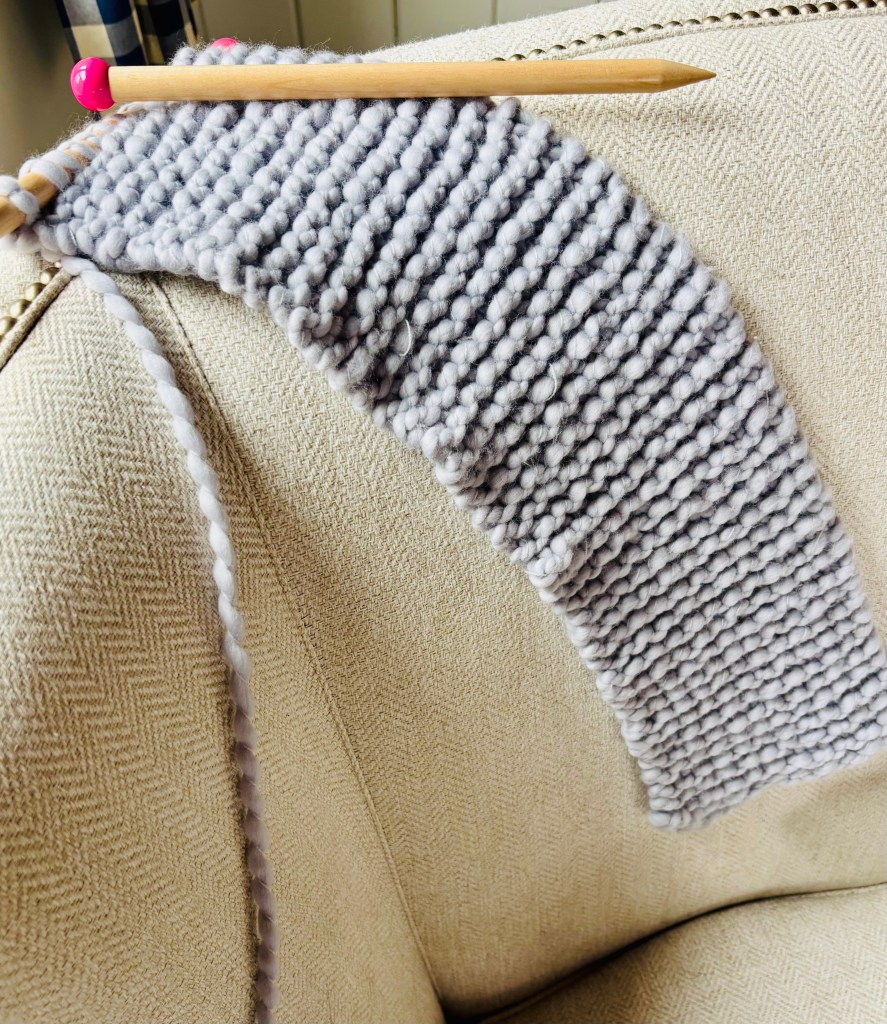
Many of you know that I have a passion for reading and writing, but this past month I have been learning how to knit. Seriously. I am halfway finished with my very first scarf, and although the beginner kit said it would take 2-4 hours to complete, I can tell you that was false advertising. Luckily, according to Punxsutawney Phil last Sunday, I now have five more weeks of winter left in which to complete it, and actually wear it, before the weather warms up! I will be working on it tonight while Jim watches the Super Bowl.
I have always wanted to learn how to knit. My grandmother was a much-sought-after seamstress, fashioning beautiful wedding dresses and bridal party ensembles in Boston in her day. That is another story. She also had a passion for crocheting, needlepoint, and crewel embroidery. I am so fortunate to have several pieces of her work in my home. They make me smile and remember her every time I see them. Jim’s mother also crocheted afghans for all of us many years ago, which we still treasure to this day.
Knitting has a very long and fascinating history that originated in the Middle East and eastern Mediterranean around the 11th or 12th century. The earliest knitted artifacts are Egyptian socks. Knitting then spread to Europe, and gradually became an important aspect of daily life, practiced by people of all genders and cultural backgrounds, and cherished as a means of providing warmth and comfort through hand-crafted clothing and blankets. Knitting was passed down from generation to generation and evolved to reflect the unique cultural influences of various regions. (A Brief History of Knitting)
Although I am a mere beginner, the benefits of knitting, once one is past the very early learning stages, are many. Knitting and crocheting can lower heart rate and blood pressure and reduce harmful blood levels of the stress hormone cortisol.
Knitting supports your brain. Research supports that knitting improves memory, attention, and problem-solving skills. A study in Frontiers in Psychology found that regular knitting enhances brain functions like task-switching and cognitive flexibility, while other research suggests it can help reduce the risk of cognitive decline, including Alzheimer’s and dementia.
Knitting is obviously a great creative outlet, can provide a sense of accomplishment, can be used as a mindfulness tool, and can boost one’s self-esteem, as well as being a fun hobby. Suddenly, I am obsessed and seeking new projects.
Reading and writing are going to need to take a back seat for a little while. I need to finish my scarf first!
 That's Another Story