Life Lessons Taught by an Agate

Crystalized Calcite in the Sun by James Mugele, note the rainbow on the right

My son, the writer and successful Montana fly fishing guide, is also an amateur petrologist, one who studies the character and origin of rocks. His lifelong passion for rocks, and currently river agate and agatized woods, is unparalleled, and has earned him the nickname – Agate Magnet. Jim and I received gorgeous tumbled crystalized calcite, agate, and agatized wood carefully crafted by James for Christmas. Mine is on an intricately knotted fish line so two rocks can dangle in my kitchen window. If I am lucky, on a sunny morning, I can glimpse an elusive rainbow in the calcite.

Agate is the most popular tumbling rock because of its color, interesting patterns (bands, eyes, moss, lace), and translucence, enhanced by an exceptionally bright polish. When James recently shared with me that his commercial rock tumbler imitates the action of a rock tumbling in a river for millions of years, I had to learn more. In The River Runs North – the Story of Montana Moss Agate by Tom Harmon, the author describes how agates are formed (excepted):

At the time of the dinosaur extinction about 65 million years ago, two-thirds of eastern Montana was covered by shallow inland seas. This catastrophic event occurred at the same time as the Rocky Mountains were formed and massive lava flows resulted. These volcanic flows lasted several million years and was the beginning of the formation of agate and agatized woods.

The book details the petrology and mineralogy (the mineral components that create rocks) of the agate formation which is all fascinating to me, and I cannot help thinking about the lessons we can learn from agate.

Perseverance, Grit, and the long approach

Perseverance is the ability to keep going, even when faced with challenges, setbacks, failures or unexpected obstacles. Grit is perseverance and passion for long-term goals, maintaining both effort and interest over years and years. Just like the agate, humans need to remember that life is a marathon, not a sprint, something a Kent School trustee told me in my first year of Headship. Tumbling in a river for 20 million years is unequaled perseverance and a good lesson in taking the long term approach to goals.

Age brings a beauty all its own

A 20 million year old agate, agatized wood, or crystal is truly beautiful to behold. Softened edges, glistening shine, clarity. After time in a rock tumbler, these characteristics are heightened. Humans need to respect the aging process much more than we do, and recognize there is beauty in wisdom and time well lived. Older age means having faced many of life’s challenges, and sharing the experiences can be beautiful and beneficial.

New is not necessarily better

The river agates are older than we can even imagine, formed through long periods of time. Their presence in riverbeds is grounding and comforting. Why do we surround ourselves with new material objects? New and disposable, man-made items? When something breaks, we replace it. Humans can learn from the longevity of the agates and their natural process of becoming. 

Nothing heals like tumbling in a river

In poetry, a river is sometimes portrayed as a symbol of perpetual change and of the constancy of time and life itself. Its healing powers are written about by Native Americans and naturists. Water soothes the soul and humans need to reflect at the water’s edge to sustain themselves. 

An agate tumbling lifelong in a riverbed is the luckiest of all.

My Year in Books

There are so many reasons why being a reader is a lifelong gift you can give yourself. The more you read, the more your vocabulary grows, along with your ability to effectively communicate. Reading improves concentration and memory, enhances knowledge, and increases imagination and creativity. Reading can also improve sleep, reduce stress, and help you relax. 

The reason I read, however, is because of the healing power of books. Books feed our soul, transport us, make us laugh, help us feel empathy, and teach us about history, and each other. 

In 2023, I read 36 books in total, both on my Kindle and in print. This does not include all of the wonderful children’s books I read aloud to Kent School students in Little School, Kindergarten and First Grade! In 2024, I will have my own children’s book out in the world, but that is another story which I will share soon.

My Top Pick of the Year is from the historical fiction genre, Horse. Based on the remarkable true story of the record-breaking thoroughbred Lexington, Horse is a novel of art, science, love, and race.

I also highly recommend Properties of Thirst, for its Shakespeare references, and themes of love, water, food, justice, revenge, sorrow, the environment, and history. Lessons in Chemistry, also focuses on food and how it rebuilds and reshapes the life of the main character. Tom Lake is for summer theater lovers and lovers of family secrets. The Personal Librarian is a portrayal of Belle da Costa Greene, JP Morgan’s assistant, a powerful figure in the New York art and rare book world of the early 20th Century, who helped build the Morgan Library collection. 

I also highly recommend Middle School Superpowers by Phyllis Fagell and The Emotional Lives of Teenagers by Lisa Damour. Both authors have been Kent School Kudner Leyon Visiting Writers in the past. Phyllis will join our community in February for the second time.

Now, what shall I read to start the New Year?!

2023 in Review

Fiction

Winter Garden, Kristin Hannah

Daisy Jones and the Six, Taylor Jenkins Reid

Someone Else’s Shoes, Jojo Moyes

Lessons in Chemistry, Bonnie Garmus

Hello Beautiful, Ann Napolitano

Demon Copperhead, Barbara Kingsolver

Cassandra in Reverse, Holly Smale

The Book Proposal, KJ Micciche

Tom Lake, Ann Patchett

The Whalebone Theatre, Joanna Quin

The Audrey Hepburn Estate, Brenda Janowitz

Covenant of Water, Abraham Verghese

Historical Fiction

The Winemaker’s Wife, Kristin Harmel

Properties of Thirst, Marianne Wiggins

Horse, Geraldine Brooks

March, Geraldine Brooks

The Personal Librarian, Marie Benedict

The Tiffany Girls, Shelley Noble

First Ladies, Marie Benedict – almost finished!

Biography

Spare, Prince Harry

Friends, Lovers and the Big Terrible Thing, Matthew Perry

Poetry

At the Narrows, Meredith Davies Hadaway, Washington College Sophie Kerr Poet in Residence

Weaving Sunlight in a Scarlet Light, Joy Harjo

Kin – Rooted in Hope, Carole Boston Weatherford

12 Moons, Mary Oliver

Professional Non-Fiction

Short Changed: How Advanced Placement Cheats Students, Annie Abrams

Digital Body Language: How to Build Trust and Connection, No Matter the Distance, Erica Dhawan

Middle School Superpowers, Phyllis Fagell

Unearthing Joy, Ghouldy Mohamed

The Emotional Lives of Teenagers, Lisa Damour

Moments of Impact, Lisa Kay Solomon

Equally Shared Parenting, Marc and Amy Vachon

Working with Today’s Independent School Parents, Rob Evans and Michael Thompson

Deep Kindness, Houston Kraft

Growing Up in Public, Devorah Heitner, PhD

Kindness Will Save the World, James Crews

Jewel of Autumn

Once when I was living in the heart of a pomegranate, I heard a seed

saying, “Someday I shall become a tree, and the wind will sing in

my branches, and the sun will dance on my leaves, and I shall be

strong and beautiful through all the seasons.”

Excerpt from The Pomegranate, Kahlil Gibran

I just bought my first pomegranate of the fall and I am so grateful. This is the time of year for the jewel of autumn to once again grace our fruit bowls. Pomegranates are a fascinating fruit with a rich history whose name derives from the Middle French pomme garnete, or seeded apple. 

According to the Pomegranate Council in Sonoma, CA (who knew?) pomegranates have been cherished for their exquisite beauty, flavor, color, and health benefits for centuries. From their distinctive crown to their ruby red arils, pomegranates are royalty amongst fruit. They are symbolic of prosperity and abundance in virtually every civilization. 

Fortunately for us, this unique fruit has an abundance of juicy seeds, or arils, to savor. Some sources claim the number of arils is exactly 613, while others allow for an error of +/- 200 – a wide variance. I can tell you from experience, whether the number is 600 or 800, pomegranates have a lot of seeds. It takes uninterrupted time, a bowl of water, and a lot of patience to extract the flavorful gems from their web of spongy skin inside the husk. But, trust me, it is so worth it.

Pomegranate seeds are superfoods containing polyphenols, powerful antioxidants thought to offer heart health and anti-cancer benefits. Pomegranates are also a source of fiber, B vitamins, vitamin C, vitamin K and potassium. There is some evidence that suggests pomegranates can protect from Alzheimer’s disease and arthritis, and aid in digestion.

Almost all of the world’s religions have recognized the pomegranate’s significance. The mythology of ancient Greece regarded this fruit as a symbol of life, marriage and rebirth, and by eating a few pomegranate seeds, Persephone tied herself to Hades as a symbol of the indivisibility of marriage.

Pomegranates are highly symbolic in Jewish tradition, most often associated with fertility and good deeds, and are an integral part of Rosh Hashanah meals. By eating the pomegranate at Jewish New Year, it expresses a wish for a year filled with as many merits as a pomegranate has seeds. A beautiful sentiment.

When I placed a pomegranate in my shopping cart today, I smiled to myself. Holding the jewel of autumn makes me anticipate our family being all together in a few short weeks at Kelsy’s October wedding, which will certainly be another story. Looking regal atop the apples and bananas in my fruit bowl, pomegranates are a strong and beautiful symbol of love. Perhaps we need to add some to the wedding florals!

Kindness and Singing

This summer, I read Deep Kindness: A Revolutionary Guide for the Way We Think, Talk, and Act in Kindness by Houston Kraft. He proposes that “practicing kindness is an essential step in helping to repair a world that has grown to be more divisive, lonely, and anxious than ever.” Deep Kindness gives us the steps we need to make real change in our own lives, the lives of others, and throughout the world. 

During the past few years Kent School has explored as a community the importance of connection, belonging, empathy, and caring. We have worked hard to restore our community in the complicated and changing times in which we live. Aristotle famously said: Educating the mind without educating the heart, is no education at all. I agree, and, because we live in a time when kindness is needed more than ever, I have selected KINDNESS as my word to keep before our learning community for this academic year. KINDNESS is a choice, a muscle we must flex and strengthen. And, frankly, it is a muscle that could use a little more of our attention. 

So where do we start? We have no choice but to start with ourselves. If you are kind, forgiving, and gentle with yourself, it will radiate out in all of your actions. Being kind has so many benefits to you and to the person who receives your KINDNESS. If we practice KINDNESS and make it a part of who we are, we can live a happier and healthier life. Scientific research shows that being kind releases feel-good hormones, reduces anxiety, improves heart health, and reduces stress. KINDNESS also builds relationships, and positive relationships new and old, bring great joy and purpose to our lives.

When my own children were growing up, I always told them to be kind above all else – because you have no idea what someone may be dealing with in their life. As educators we need to remember that each child comes to school with a set of experiences, issues, concerns, and questions that differ from his or her classmates. Our words matter. They are capable of inspiring or hurting. We all must practice and learn to be kinder to one another.

Some of you know that Mary Oliver is one of my favorite poets. Today, on her birthday, I want to share one of her lines of poetry that resonates with me from the poem Evidence. 

I believe in kindness. 

Also in mischief. 

Also in singing, 

especially when singing is not necessarily prescribed.

When I was a child I was not allowed to sing at the dinner table. That is another story, but I guess that was a time for my parents when singing was not prescribed. Mary’s words, however, mean that we should all take a moment to sing – whatever your singing might be – when the time is not necessarily right to express your joy. Be kind and do it anyway.

Lessons from a Seamstress

I have spent a few hours this summer with the seamstress who is making alterations on Kelsy’s wedding dress. Defined as a woman who sews, especially one who earns her living by sewing, our seamstress is simply a magician. A woman who sews does not define her. 

Have you ever noticed how strange our language really is? Why is a tailor defined as a person, usually male, who makes or alters men’s clothing. Does there always have to be a male and a female title? In my profession, back in the day, women leading schools were referred to as the headmistress and men, the headmaster. Thankfully, today that antiquated language is replaced by head of school. Did you notice that “stress” is a part of the female titles? Wonder if that was intentional? That is another story.

I have been thinking alot about my HoS colleagues this week as we all begin a new academic year. Trust me, we could all learn a few lessons from a skilled seamstress/tailor. Here are my takeaways from the summer of the dress.

  1. Active listening before action is critical. Once a cut to fabric is made there is no return. The same is true for actions. Therefore, listening, really listening, is a must. Often in schools, we meet with parents who are unhappy with us. Our first reaction, sometimes, is to speak to defend the teacher’s or the school’s action. What if we flipped it and just kept listening, asking parents to help us understand. Really understanding all of their feelings, instead of dismissing them, might be a better way to forge a path forward. The more we learn by listening, the more we can apply in our actions.
  1. Creativity is essential for problem solving and magic. On a regular basis, seamstresses deal with problems – the dress is too large, too tight, too long, or needs new straps, a zipper, or buttons. Whatever the problem, creative thinking is required to make it work – and a pin cushion. In schools, we often need to think critically and creatively, not only to solve problems in math and science, but to reach students in the way they learn best. Heads and teachers often need to be flexible and solve individual problems in individual ways – many times in a day. And, just as the dress fits perfectly, so too is the magic of seeing a student when the light shines brightly after a struggle. 
  1. Kindness and a positive attitude fixes everything. It is stressful and overwhelming to be the bride. So many decisions to make on a short timeline. It reminds me of being a HoS and entering a new academic year. So many decisions ahead, some that you cannot even imagine in September. The key – kindness, to others and also to yourself. I watched in awe as Kelsy’s seamstress calmed her nerves, listened to her every wish, kept a positive attitude, and recited everything she was going to do back to us in the kindest tone. She knew her audience. This is such a good reminder to me – be positive, kind, and helpful.

I am so grateful that Kelsy has chosen to use lace from my dress, the dress worn first by my mother, and handmade with love by her mother, a seamstress. It has been emotional and joyful to see Kelsy’s vision unfold in the gentle and able hands of Ciara’s Alterations. 

And, as my grandmother used to say: Measure twice, cut once!

Photo: Beatrix Potter, The Tailor Mouse

Love Letter to Maui

A unique benefit at my former school was the endowed Kent Sabbatical Program offered to faculty and administrators after seven years of service. Established to ensure that educators who had dedicated their careers to Roland Park Country School would be able to recharge over time and pursue a passion which could be shared with the school community. Proposals were required and once accepted you could plan your time away with a generous stipend.

My proposal was to live in a home on the ocean on Maui and write a collection of poems. It was a magical week with my family. Each morning I wrote for a few hours at a picnic table literally perched on a ledge overhanging the ocean while the house full of teenagers was silent. My view was an endless crystal clear blue ocean. The perfect setting for reflection and renewal. It was truly a dream come true.

Maui did not disappoint. From surfing on the North Shore (the kids, not me), to driving the Road to Hana, to swimming with turtles in our own backyard, to hula dancing at a luau at the Polynesian Culture Center, to visiting Lahaina, the island’s beauty and its people filled our hearts and souls. 

We were treated like Ohana on Maui. Family. We have never forgotten the kindnesses we received there. Our hearts go out to the families who have lost loved ones, their homes, and their towns, when the nightmare fire erupted recently fueled by hurricane winds sweeping through dry, wild grasses. The devastation is heartbreaking to see.

For me, I always think first about children having enough food to eat. As such, I am choosing to support the Maui Food Bank accepting donations that will pay for meals provided to displaced residents. If you are so inclined, here are additional local resources accepting donations:

  • Hawaiʻi People’s Fund: Providing immediate relief to those directly impacted by the wildfires on Maui Island. 
  • Public Schools of Hawaii Foundation: Partnering with the state Department of Education to support school communities in West Maui through Oct. 1.
  • ‘Āina Momona: Establishing an emergency fund for Maui County first responders, including Firefighters, Lifeguards, and Emergency Medical Technicians. 
  • Maui Humane Society: Supporting shelters for displaced people and animals, and caring for injured animals. 

Stay Maui Strong

Match Day

Tonight, the USWNT will play the Netherlands in their second game in the Women’s World Cup. It is Match Day. Our team is the most successful in international women’s soccer, winning four Women’s World Cup titles, four Olympic gold medals, and nine CONCACAF Gold Cups. I will be watching tonight.

In the medical profession, Match Day causes much anticipation among thousands of graduating medical students on the third Friday of every March. Their Match Day is the national process of securing a residency placement and it is one of the most memorable and consequential days in the life of a medical student.

MatchDay is also a soccer gaming company composed of a global team of video game veterans, united by their love of soccer and working together to develop a new category of games for the sport’s 5 billion fans. From their website: It all starts with a ball, and we unite as one. Under the banner of the beautiful game. To spark real connections and pull down the barriers that hold us apart.

I have had the pleasure this summer of creating a Match Day for several candidates seeking employment and purpose at Kent School. It has been incredibly gratifying and humbling to see the joy in the faces of candidates when a position is offered. I cannot wait to welcome new employees to campus at the end of August for their official orientation, although I have already seen several of them on campus beginning to get their classrooms and offices ready. 

It all starts with a mission, and we unite as one. Go Ospreys!

Dressing Barbie

With a nod to the movie opening next week, some of my fondest childhood memories include Barbie. I know that is not something you might expect to hear from a self-proclaimed feminist, but it is true. Barbie celebrated 60 years in March 2022 when I read Dressing Barbie by Carol Spencer. The author designed thousands of outfits for Barbie over her 35 year career at Mattel. 

The iconic (and sometimes controversial) Barbie doll was invented by Ruth Handler, co-founder of Mattel with her husband Elliott, whose daughter was named Barbara. Barbie was introduced as a teenage fashion model in 1959 at the American Toy Fair in New York City. Barbie originally came as a blonde or brunette, and I had the brunette version as a young girl. I loved my Barbie doll collection, but, most importantly, I loved her clothes. Barbie always dressed in the most current and exciting fashions of the day, and because it took two years for a design to become available in stores, Carol Spencer always had to be forward-thinking. Girls would certainly know if Barbie’s clothes were dated and out of fashion.

I was most definitely inspired by the fashions Barbie was sold with, but I had a secret weapon. My grandmother. Nana was a seamstress by trade who specialized in creating custom bridal dresses in the 1960s and 1970s. She had a huge basement workshop in her home in Boston which served as her sewing room, complete with a large cutting table that my grandfather made for her of knotty pine. She had several sewing machines that were operated by foot pedals, and spools and spools of vibrantly colored thread hanging neatly in rows. I loved her sewing room and spent long hours watching her meticulous work. I witnessed many bridal party fittings, and was so proud of my grandmother’s handiwork. She was a designer and a perfectionist. 

(Editor’s note: Next month I will accompany Kelsy when she goes for a second fitting of her wedding dress with her seamstress. We are taking my wedding dress, worn first by my mother, and handmade by my Nana. Kelsy is going to incorporate some of the Italian lace into a belt for her dress. And we have plans for all of the silk roses my grandmother painstakingly sewed down the back of the dress. It is another story I will write about soon!)

When my grandmother began to outfit my Barbies I knew I was the luckiest girl around. She made dresses, coats, skirts and slacks for my doll in the latest fabrics and fashions. Sometimes she made me and my Barbie dolls matching outfits! My friends may have had more Barbie accessories – like the car, boat, and dreamhouse, but I had the most clothes by far! When I saw the title of Carol Spencer’s book, Dressing Barbie, I immediately thought of my grandmother in her sewing room. She dressed Barbie for many years as well. 

Barbie does get a bad rap sometimes, especially as it relates to body image, with her height and her busty, small-waisted build – not to mention her feet, pre-formed to fit into high heels. Spencer realized the times had changed by the 90s and she wrote: I don’t think she was so out of proportion – people don’t understand doll scale. And, she’s a doll! 

Spencer helped create many different career Barbie dolls over the years and is proud of her work. She wrote: During the women’s movement all of us designers belonged to the National Organization for Women, but we didn’t flaunt it. It was this quiet goal to start promoting women. I wanted more choices for Barbie. I wanted more choices for myself.

Today, an estimated 164 Barbies are sold per minute. One of my personal favorites, and Mattel’s best-selling Barbie of all time, was the Totally Hair Barbie introduced in 1992. She wore a Pucci-esque mini dress designed by Spencer. Hair drama and high fashion in one doll. 

I may have to see the movie!

Life Lessons from a Sea Turtle

On Father’s Day morning, I woke to the glorious sight of a sea turtle nest built directly in front of our condominium in Satellite Beach, FL. I saw the intricate and unmistakable pattern of sea turtle flippers as they traversed the beach to the dune where a wildly dug pit with sand piled high around it was created. I was overjoyed.

Many of you know that last summer I wrote Sea Turtles Teach Enduring Lessons for Well-Schooled, the site for educator storytelling. I have a passion for these savvy creatures from whom we can all learn life lessons.  

I watch with great interest each morning as members of the Marine Turtle Research Group of the University of Central Florida drive up the beach in their Gator to check on nests, and seek new ones. They also found the nest on Father’s Day and posted a sign for it as they searched the area with clipboards noting tides, currents, and locating tracks in the largest loggerhead sea turtle nesting area in the Western Hemisphere. Volunteer opportunities exist for oversight and overnight monitoring. This is my retirement plan.

Sea turtles have survived in the Earth’s oceans for the last 110 million years. Recent research has found that turtles have remarkably slow rates of aging. Thus, they can live a very long time – 50 to 100 years. They migrate thousands of miles in their lifetime through ocean basins and high seas. 

Once they are fully grown, turtles head back to where they were born to mate, even if they have not been there for 30 years. Males never leave the ocean, enjoying a Father’s Day swim, while females come ashore to lay their eggs on sandy beaches. In a single nesting season, females lay between two and six clutches of eggs, each containing 65 to 180 eggs. That means in their lifetime they could produce 4,200 eggs! 

The sea turtle’s perseverance is extraordinary. Here are my top three life lessons we can learn from sea turtles.

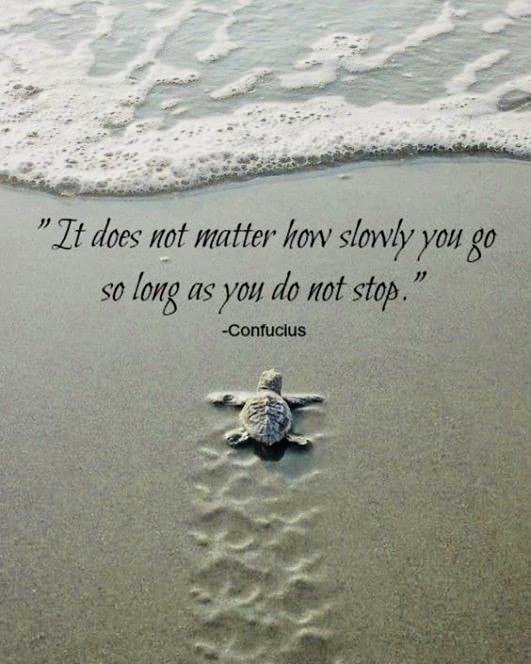
Lesson #1 It does not matter how slowly you go, so long as you do not stop. (Confucius) 

From the moment a baby sea turtle leaves the confines of its nest danger is ever present. While it may leave the nest with its siblings, much of its singular journey will be spent alone. Turtles understand it is a marathon, not a sprint. Their undertaking takes place over a long distance and over a long period of time which demands great physical and mental stamina. Turtles, known for slow and steady progress, model endurance – take your time, swim confidently through fast waters, learn from failure, and always find your way home. 

Lesson #2 To know the road ahead, ask those coming back. (Chinese Proverb)

Mother loggerheads do not guide their children to the ocean, nor do they guide them through life. Instead, female sea turtles give their children the opportunity to emerge from a nest close to the water, and let the moon and the sun guide their journey. Sea turtles always come back to the beach area where they were born to mate. Home is a powerful beacon calling them from the ocean to the security of familiar sands in which to build their nest. The best journey always brings you home.

Lesson #3 Live your life and forget your age. (Norman Vincent Peale)

Like sea turtles, we can find ways to age more slowly by being grateful and mindful, finding passions, building and deepening relationships, and looking for ways to simply have fun – outdoors, if possible. 

Lights are required to be off on the beach at 9:00pm during turtle nesting season (March to October) so that turtles can find their way to the shore using the moonlight to guide them. Proud to have assisted in the process of one amazing nest!

First Light

For some reason, the phrase We go at first light has been stuck in my head for weeks. Maybe it is because, finally, I am waking in the light to go to school, and I am very attuned to the first light of the day. It may also be because this week marks the AIMS 10 Year Accreditation Visit at Kent School. We have been reflecting as a community on every detail from mission to program to experience for two years to unearth and showcase all of our highlights. Or, it may just be because I read it recently in a book.

First light as a phrase has been used since the 1700s, presumably dating back to a time when people had no other way of telling the time. Morning twilight, or dawn, is the time of day when light first appears, before the sun makes its appearance. In the Military, first light is the beginning of morning nautical twilight, when the center of the morning sun is 12 degrees below the horizon. In astronomy, first light is the first use of a telescope to see star light.

To me, the phrase signals adventure and the start of a journey. It is also in its simplest form, poetic and romantic. It corresponds to a magical and peaceful time of day when only poets and authors are taking notice of the awakening. The birdsong and the gentle river currents feed the creativity of the soul. All things are possible.

Although we don’t use the phrase first light in education, we should. I have witnessed many times myself at Kent School that exact moment when light first shines in a student’s eyes as they master a new concept. Anne Sullivan, Helen Keller’s teacher captured it perfectly: My heart is singing for joy this morning! A miracle has happened! The light of understanding has shone upon my little pupil’s mind, and behold, all things are changed!

If you need me at first light, I will be on the porch, writing.

Photo: Satellite Beach, FL